

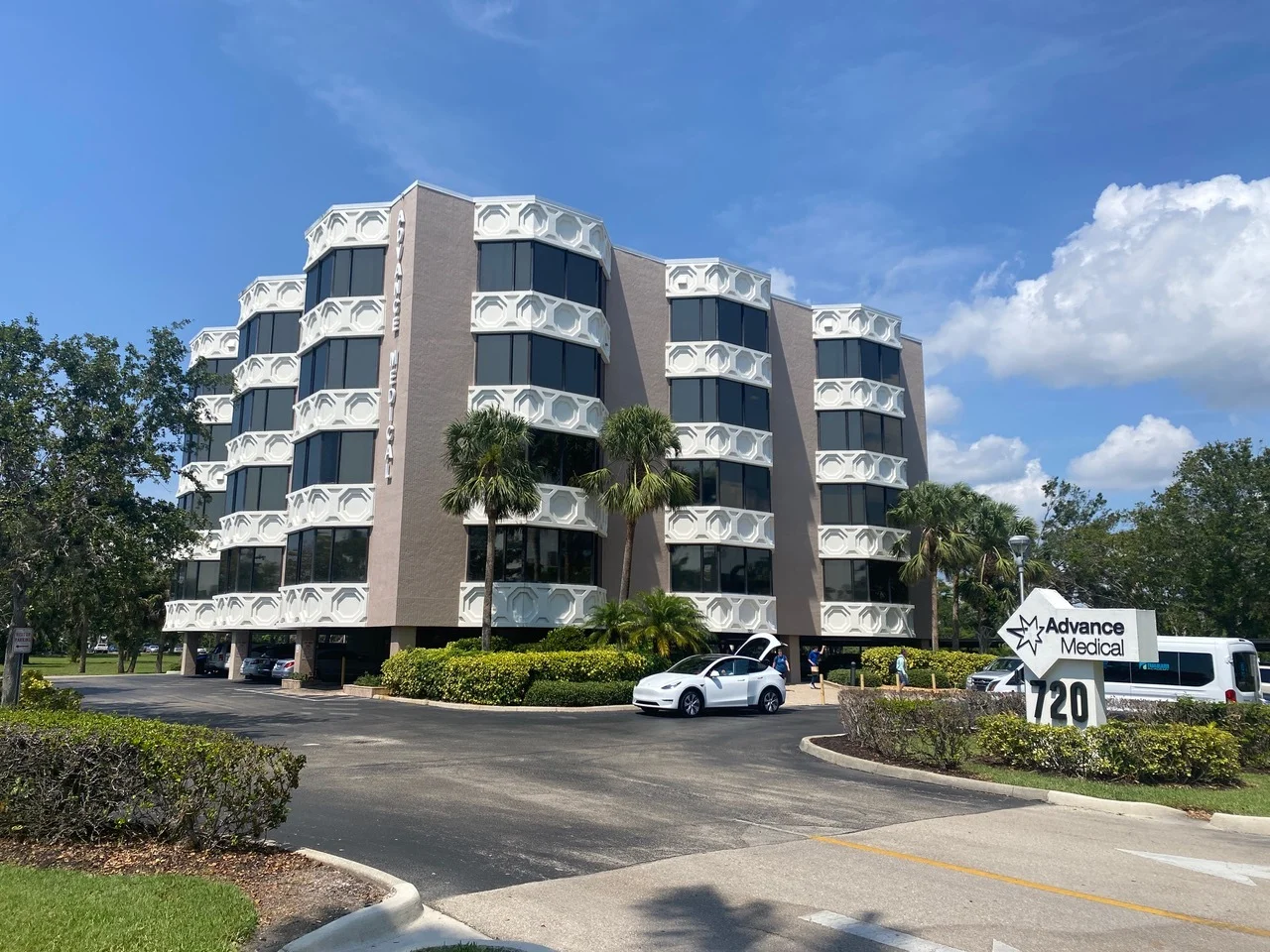
A medical office building is worth what a buyer will pay for it, and four things set that number: the income the building produces, its size, measured correctly, what comparable buildings actually sold for, and who the likely buyer is. The price per square foot a neighbor’s building sold for is a great starting point, but it’s not the full answer.
Here is how each of the four components works.
The figures and charts below come from Miami-Dade County, the market we’re covering this month.
Use them as a point of reference. Prices vary from market to market, and if you want the numbers for yours, ask us and we’ll pull them.
How does the income set the price?
Most commercial real estate is priced on its net operating income: the rent it collects after the expenses the owner pays. The link between that income and the price is the cap rate.
The arithmetic is one division. A building that earns $150,000 a year in net income and sells for $2.5 million trades at a 6% cap rate. Turned around, the same 6% tells you what that income is worth: $150,000 divided by 0.06 is $2.5 million.
The useful part is what happens when the income changes. If that building’s rent rose by $20,000 a year, at the same 6% it would be worth about $333,000 more. That is why the lease inside a building carries so much of its value.
If your practice is the tenant, you could be renting it to yourself at a favorable price, and that’s great, but the rent it pays you is also the income a prospective buyer will see. This is something to consider if and when the time comes to sell your property. We cover what that means in a separate article on sale-leasebacks.
How does the size of my building affect its value?
Size works on value in two ways: how the building is measured, and how big it is.
Start with the measurement. You would expect a building to have one size. It usually has several:
- Usable: the space inside the suite that you actually occupy.
- Rentable: usable space plus a share of the common areas, such as lobbies, corridors and restrooms. Leases are usually billed on this.
- The county’s figure: what the tax roll records.
- The recorded figure: for a condo unit, the area stated in the recorded declaration.
These can differ, in some cases by hundreds of square feet, and since price per square foot is the number everyone quotes, the size you start from changes the answer.
Here is how much it can matter. Picture a lease that bills about 300 square feet less than the unit’s correct rentable area. The rent per foot is right, but it is applied to the wrong size, so the income comes up short every month. Correct the size and, at the same sale price, the cap rate moves by about half a point. Nothing about the building changed. This is why it’s so important to have an expert’s opinion of value, to ensure you’re not leaving anything on the table.
Then there is how big it is. Smaller buildings sell for more per square foot.
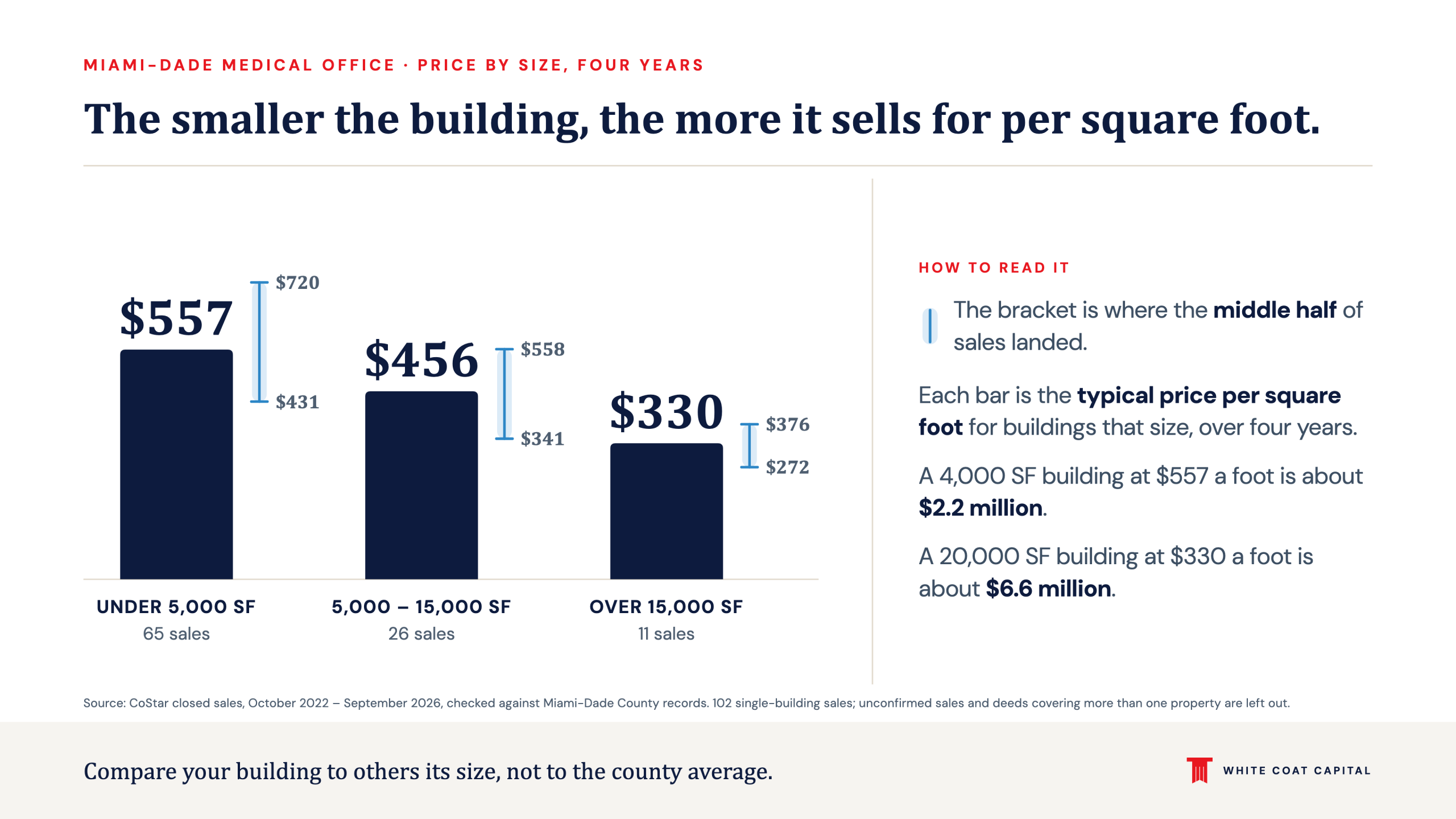
So when someone quotes a price per foot for your building, ask two things: which square footage they used, and whether the sales behind it were buildings your size.
Which sales should I compare my building to?
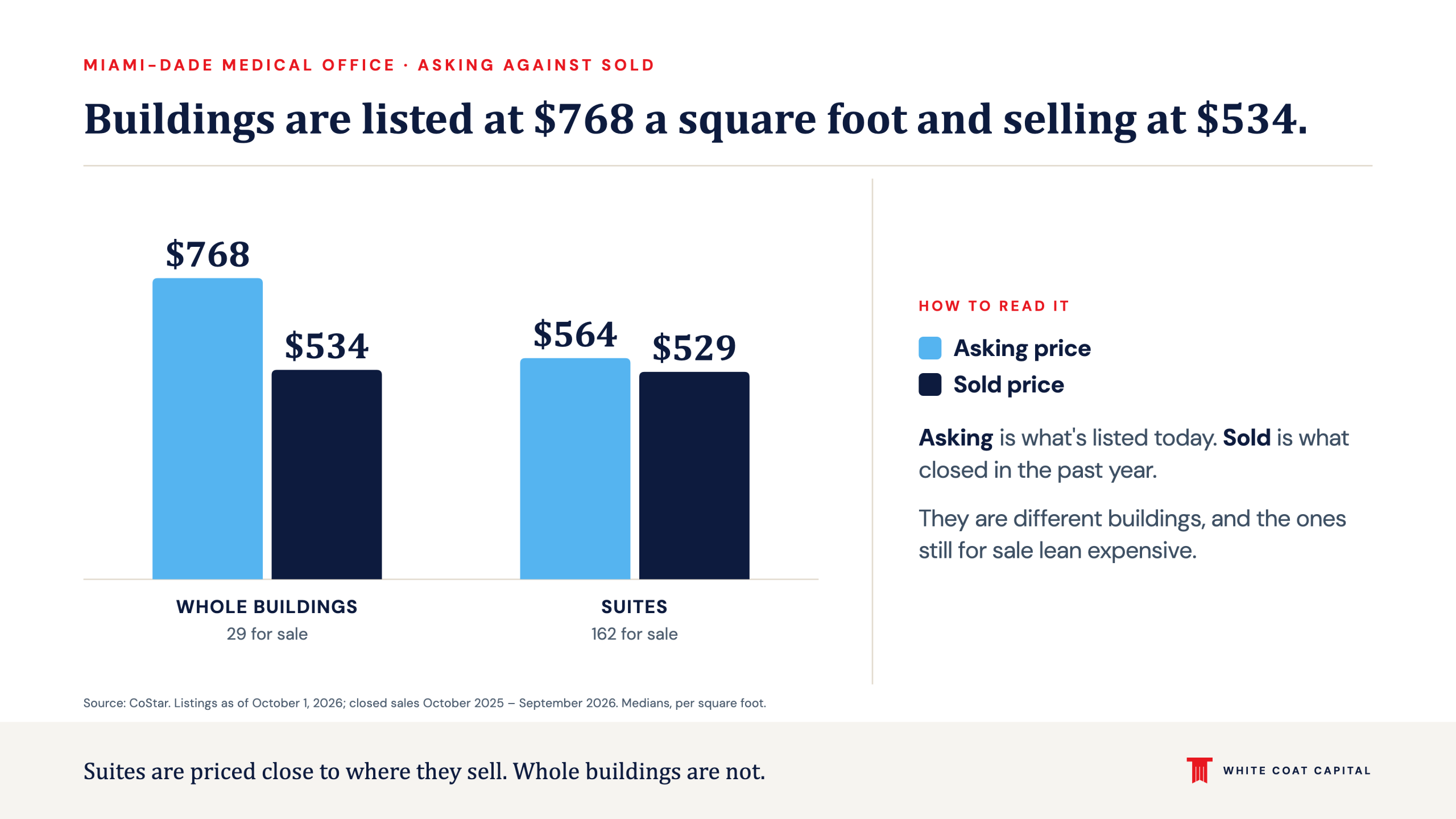
Closed sales of buildings close to yours in size and location. That’s what matters. We see asking prices all over the board from hopeful sellers, but at the end of the day, a comp can only be assessed when a property is sold and the deed is recorded.
An asking price is what a seller hopes for. A sale is what a buyer paid. In Miami-Dade on October 1, 2026, whole medical office buildings for sale were asking a typical $768 a square foot, while those that sold over the past year went for $534. They are different buildings, and the ones still for sale lean expensive.
Why does it matter who buys my building?
Medical office buildings sell to two kinds of buyer: practices that will move in, and investors that will collect rent. They pay differently. In Miami-Dade over the past four years, practices buying a building to move into paid a typical $540 a square foot, and investors paid $480, for buildings of about the same size.
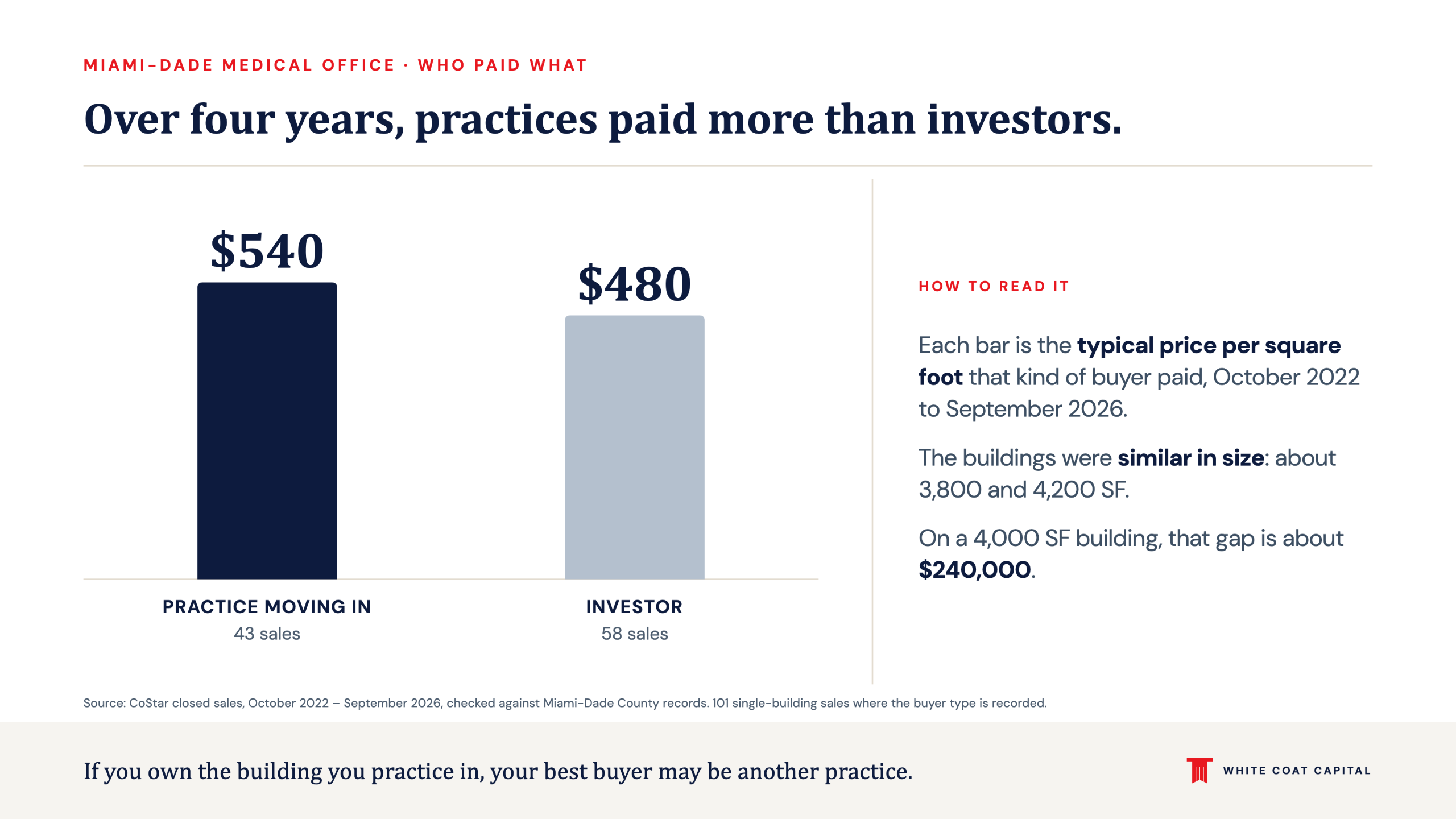
paid $480 across 58 sales.
.
That is the four-year picture. Year by year it moves. Practices paid clearly more in two of the four years. In the other two, including the past twelve months, the two paid about the same. Treat it as a tendency, not a rule.
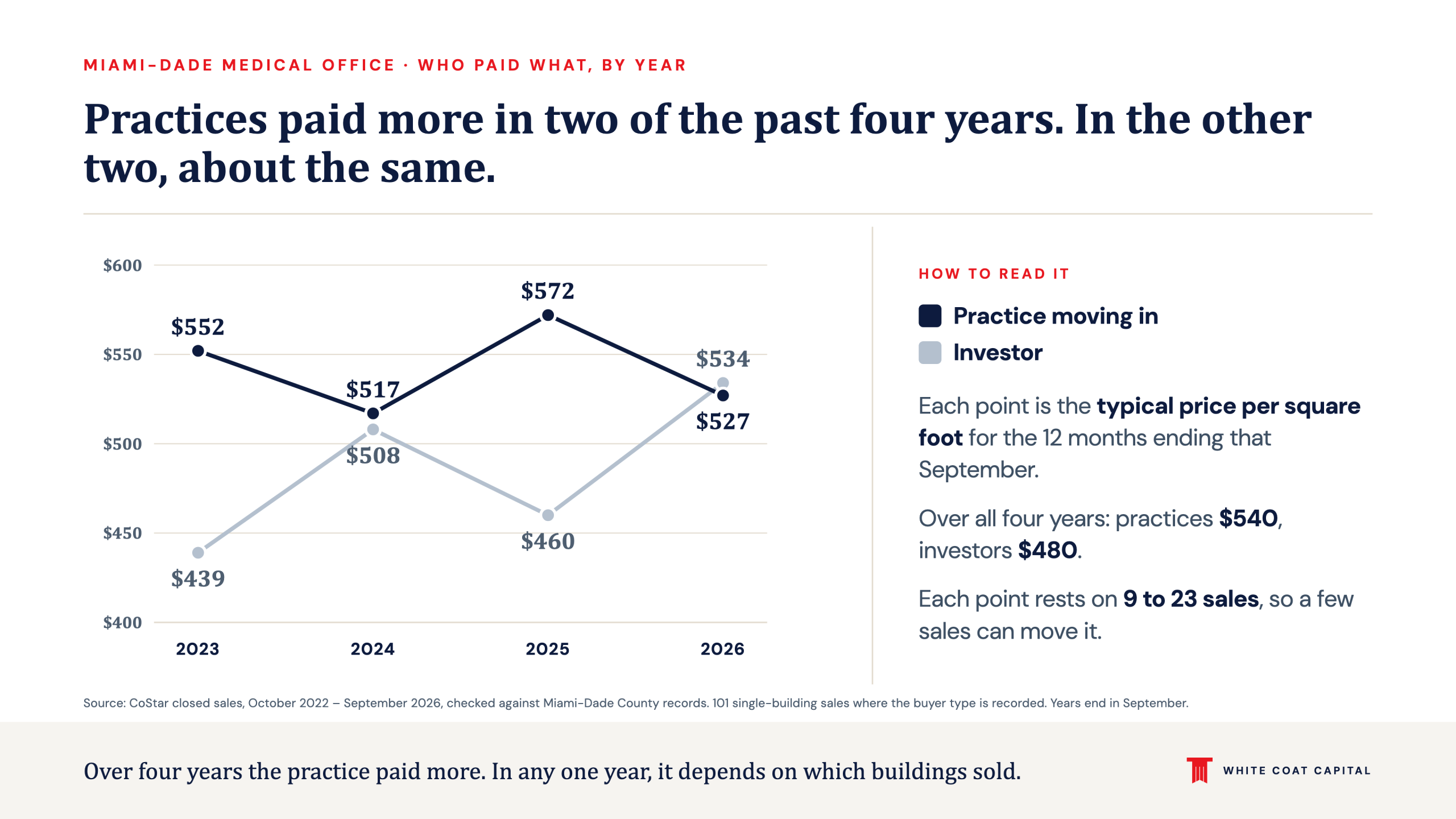
A practice is paying for the location and the build-out it would otherwise have to create. That has a consequence worth knowing before you sign a long lease: a building that a buyer could move into can sell to either kind of buyer, while a building with a long lease in place can only sell to an investor. The lease you sign today decides which buyers you will have later.
How do I find out what my building is worth?
Put the four together for your building: its income, its correct square footage, closed sales of buildings like it, and the buyer it is most likely to attract. That is what a Broker Opinion of Value does.
To produce one, we need the address, the lease or rent roll if the building is leased, the square footage you have on record, and anything you know about its condition.
If you own a medical office building in Florida and want to know what it would sell for today, book a discovery call and request a Broker Opinion of Value. It is free, confidential, and there is no obligation.
Request a Broker Opinion of Value
Frequently asked questions
Most buyers divide the building’s net operating income by a cap rate. A building earning $150,000 a year after the owner’s expenses, at a 6% cap rate, is worth about $2.5 million. Closed sales of similar buildings nearby are the check on that number.
More buyers can afford them, including practices buying a building to move into. In Miami-Dade over the past four years, buildings under 5,000 square feet sold for a typical $557 a square foot, against $330 for buildings over 15,000.
No. Asking prices are what sellers hope for. Use closed sales of buildings close to yours in size and location.
In Miami-Dade over the past four years, practices buying to move in paid a typical $540 a square foot and investors paid $480, for buildings of about the same size. The gap changes from year to year.
Sources: CoStar closed sales, Miami-Dade County medical office, October 2022 to September 2026, checked against Miami-Dade County records; unconfirmed sales and deeds covering more than one property are left out. Asking prices from CoStar listings as of October 1, 2026.
Join the conversation
Reply